On my third day in Iceland, I awoke to the gentle baa-ing of sheep just outside the window. I hadn’t forgotten where I was — in a hotel room in Iceland with Haider and Raz (whom I’d just met still less than 24 hours previously) — but I didn’t remember there being any sheep when I’d fallen asleep.
We woke up, showered and headed out to the main building for the complimentary breakfast (score!), but as soon as we stepped outside, we stopped dead in our tracks. It’d been pitch black the night before except for the aurora, so we had no idea that our hotel was nestled up next to the steep, craggy wall of a glacial mountain. Seagulls were wheeling along it far above our heads, and below was a lush, peaceful field full of grazing sheep.


After breakfast, we headed out to the waterfall Skógafoss, not even a kilometer away. Skógafoss was my first lesson in Iceland’s infinite ability to top whatever you think can’t possibly be topped. The previous day, while watching the sunset through the last waterfall, Seljalandsfoss, I thought to myself, this is it. Nothing on this trip could possibly be better than this. Well, Skógafoss was.
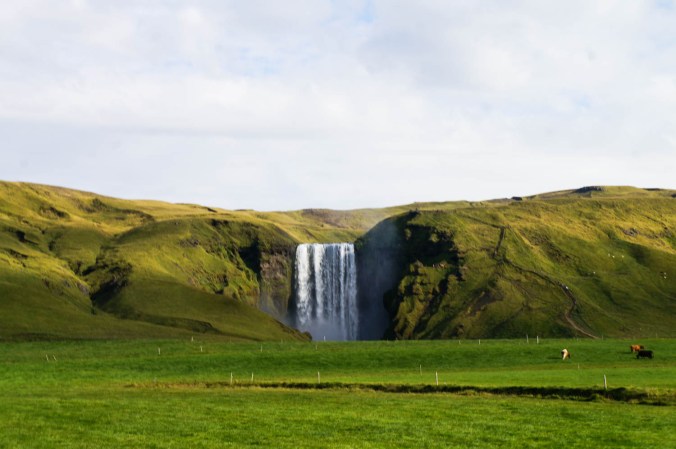
Water surges over the top of the mountain in a thick, powerful gush, then turns into a gentle, trickling stream — meaning that you can walk right up to the base of the falls, coating yourself in its spray.


The constant mist also means that any time the sun is shining, there’s a rainbow at Skógafoss. Position yourself correctly, and you can see the rainbow stretching overhead from end to end.
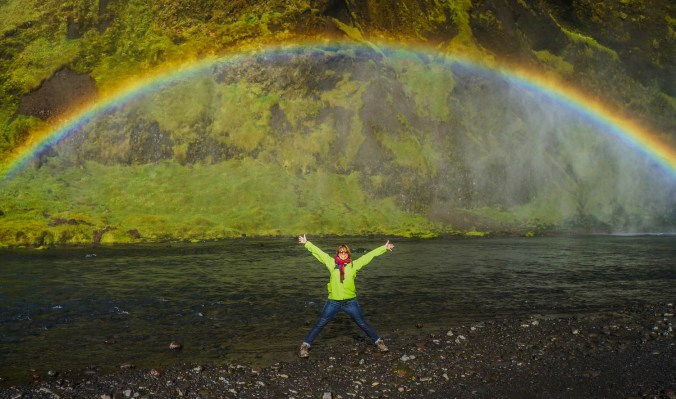
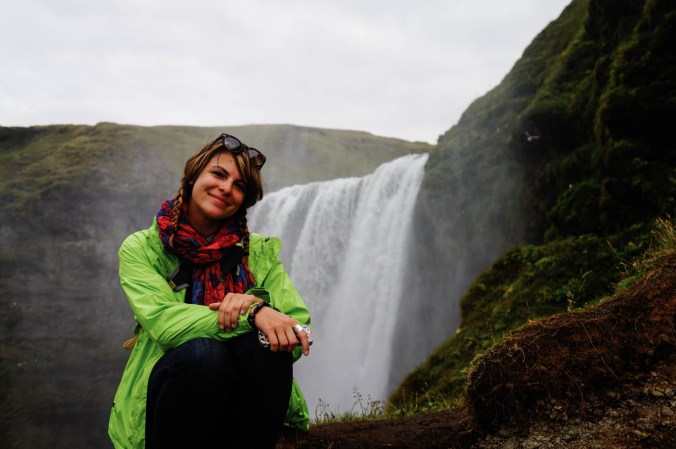
The fall is breathtaking from its base, but of course, that experience is quickly topped by other angles. We trekked up the steep staircase to the side of the falls to see it from halfway up.
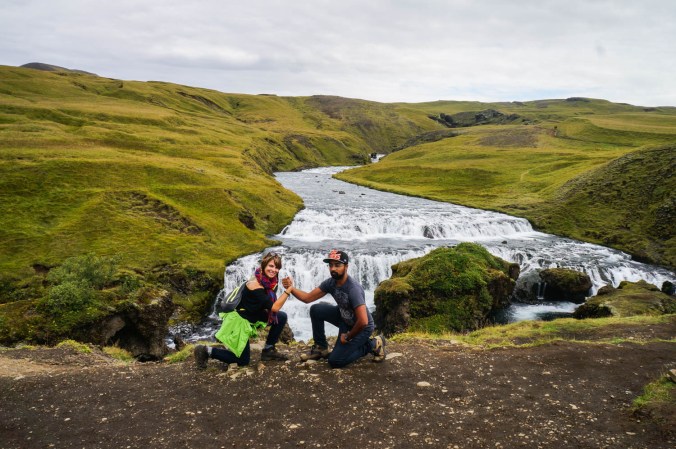
After soaking in that view, we continued the climb to the very top. I figured we’d have a look and climb back down, but the trail continued across the top of the mountain, toward where the peak of the glacier was visible beyond. We walked along it a ways and I found myself transfixed by the sight of the white-water rapids and turbulent mini waterfalls that led up to the river’s descent over the edge of the cliff.
We also found little piles of stones that visitors had created to liven up the lush landscape.


I chose a perch on a rock overlooking the fierce glacial river and let my mind wander, happy to be alone and feeling so present. Surely, I thought, nothing could possibly top this moment. It was the most beautiful place I had ever seen.

Next, we drove back to Vík to visit its black sand beaches. Along this section of the coast, old chunks of lava are ground into fine sand by the ocean’s waves. It feels softer than most beaches I’d been to before, yet has an eerie pitch-black color. Closer to the lapping waves where the sand is wet and engraved with lines from the streams of water, it took on the look of an oil slick.


I kicked off my shoes and strolled barefoot across the sand, pausing here and there to hunt for volcanic stones. The black sand was cool enough, but the fact that the beach was framed by towering dark green cliff faces made it all the more amazing. Just past the breaking waves were huge boulders that had obviously tumbled down from the mountain at some point and come to rest upon each other. Further down the coast were the crazy silhouettes of basalt rock formations peering up from the water.
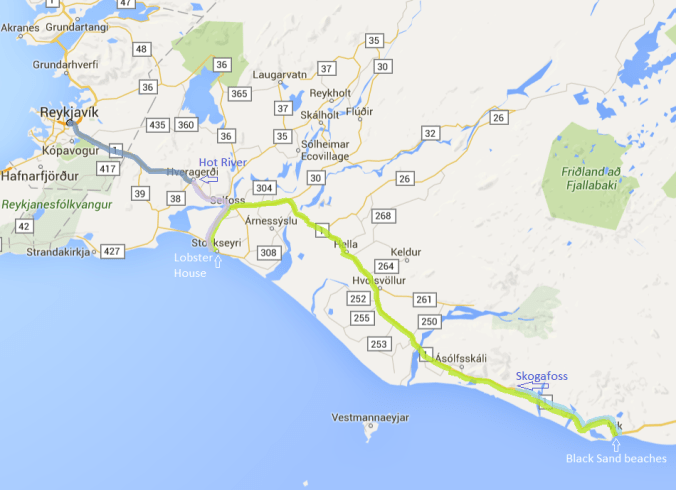
Eventually, we left Vík behind to head back toward Reykjavik. Raz wanted to hike to a hot river, which sounded cool, but Haider and I were fixated on one thing: lobster soup. Our first night in Reykjavik, we’d gotten into conversation with another couple from Philadelphia on their last night in Iceland. The biggest thing they raved about? The incredible lobster soup at this little coastal town. They couldn’t remember the name of the restaurant and only had a vague idea of the town’s name, but we were able to figure it out: Stokkseyri.
We drove an hour and a half to Stokkseyri, during which Haider demonstrated his incredible aptitude for learning to drive stick. We’d both practiced a bit under Raz’s supervision the previous day, but I quickly got flustered while Haider flourished. Now he was taking on hills and traffic circles fearlessly, downshifting and upshifting with ease.


Stokkseyri was a tiny and adorable town on the seaside, about 45 minutes from Reykjavik. As we approached it we realized that we still had no idea what the restaurant was called, but that turned out to be no problem — of the town’s handful of buildings, one was located directly next to the ocean and emblazoned with a huge painted lobster on the wall.
While we waited for a table we perused menus on the counter which spun delightful tales of the fabulous lobster cavorting with mermaids in the sea before visiting us landlubbers to take our tongues on a magical journey. It impressed upon us that people risk their lives in all weather to reach Stokkseyri for just a few spoonfuls of their lobster soup, which is made with “cream, tomatoes, charm and passion.”
The charm and passion of the place were obvious, and the rich, creamy bisque was out of this world. We gorged ourselves on soup, tasty sides and fresh-baked bread — then downed multiple cups of coffee to stave off the impending food coma.
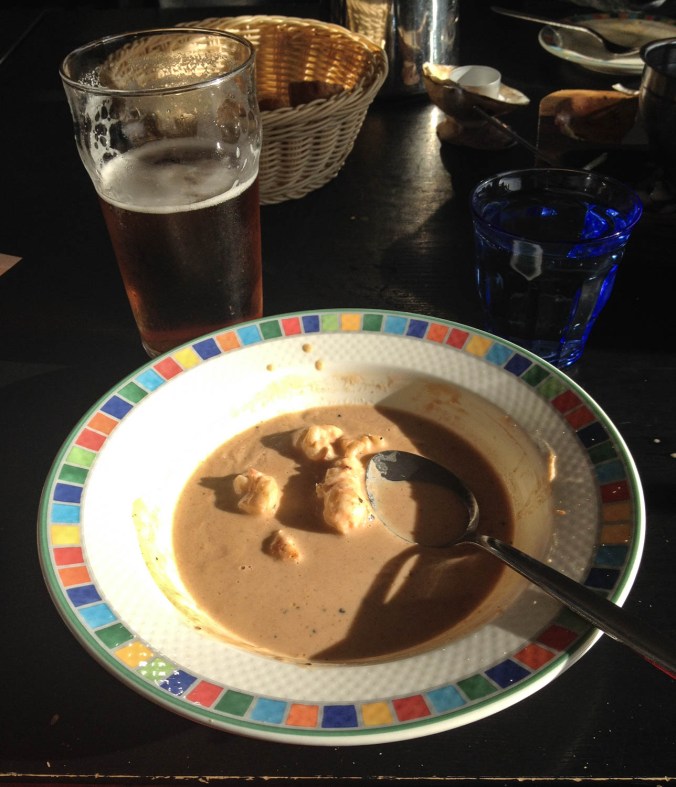
Next up, the hot river hike. I’ll admit: I was not into this hike. I was still stuffed with lobster bisque, and despite the coffee, still a little worn out from the busy last few days. We were so close to Reykjavik and I just wanted to get back to Ryan and Joe’s cozy apartment. The sun was setting fast, and it didn’t seem likely that we’d have time to finish the hike (an hour there and an hour back) before dark. But Raz was on a mission, and we didn’t want to let him down.
After getting a little lost, we reached the foothills of Reykjadalur and started trekking up. The path was steep and festooned with plumes of steam from hot springs that dotted the hillsides. Feeling fat and lazy from my lobster feast, I just wanted to take my time and putz around the springs. Raz, descended from Nepalese sherpas and rocking muscles built by a decade of San Francisco hills, wanted to power through the hike as fast as possible to get to the river well before nightfall.
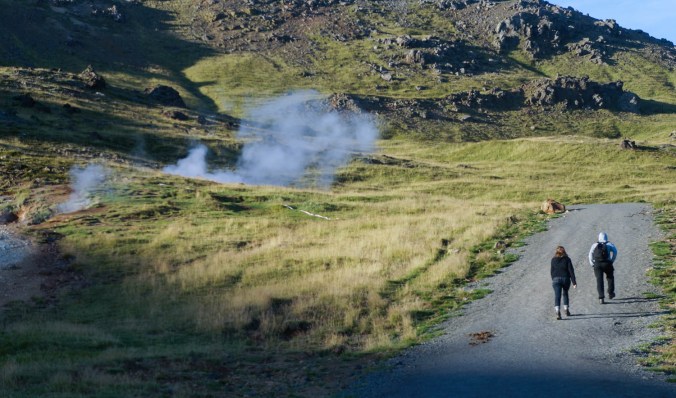
I tried to keep in mind the lesson I’d learned at Gullfoss falls the day before — it’s always worth it to see a path through to the end in Iceland. But the view of the hot springs all around me was already incredible, the sun was sinking fast, and I didn’t see the point of rushing through to the final destination. “Go ahead, don’t wait for me,” I insisted after a while. “It’s okay if I don’t make it to the end, I’ll just catch you guys on the way back.”
Raz seemed to not comprehend this mindset, so reluctantly I picked up the pace. Though tough, the hike was truly amazing, with the path winding up and down and around the peaks and valleys of craggy mountains with scrubby vegetation and surreal streams of sulfur-smelling steam.


Hilariously, we ran into Sebastien — the hitchhiker we’d picked up the day before, when we’d just started our journey with Raz. It already felt like it was ages ago. His newest travel companion assured us that we were nearing the end of the hike, but warned that we were running out of daylight.


I still didn’t get what was so special about the end of what had already been such a cool trek, and thought about suggesting that we just turn around and head back early. But then we turned the corner, and there it was: the hot river of Reykjadalur.


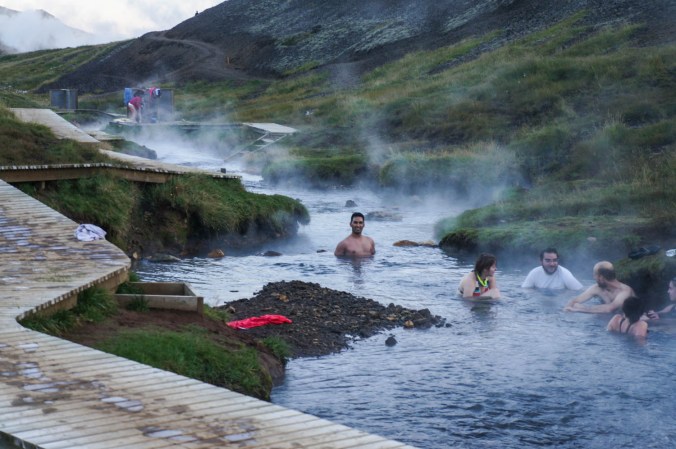
Steam billowed up from the river into the air, and in its waters was… a fucking party. People lounged in their bathing suits, stretched out in the water relaxing, chatting with their friends, drinking beer, passing around bottles of liquor. A little boardwalk was built up along a section of the water, complete with rudimentary changing areas for a bit of privacy.
Whaaaaaaaaat.
As badly as I wanted to get in, it still took a bit of convincing. I hadn’t brought a towel or a bathing suit, and I didn’t want to hike all the way back in damp clothes. But quickly I realized that I had to seize the opportunity to enjoy this weird, surreal, one-of-a-kind place, and stripped down to my skivvies. We all stepped into the water only to find it scalding hot, too warm to bear.
A Frenchman lounging lazily just downriver from us called out, “No, no — over here!” It turned out that just a few feet down from where we’d attempted to get in, the simmering lava-heated river mingled with an icy glacial stream. We repositioned ourselves just at the intersection of the two, marveling at the lapping flow of hot-hot-hot then cold-cold-cold and the seconds in between of utterly satisfying just-right warmth. For his part, Raz embraced the heat and went flopping around in the shallow depths of the hot stream. As he awkwardly rolled and splashed in the bizarre steaming water, it reminded me of some weird primordial stage of evolution, like a fish just learning to leave the water.
Eventually, we relocated a few more feet down the river, where it was deeper and the hot and cold flows had had time to mingle together to create the ideal temperature. It was a perfect natural hot tub. We rested our heads against the grassy bank and struggled to comprehend this strange and amazing place we’d found ourselves. We also got to chatting with fellow travelers sharing our section of the river, mostly Americans who’d also linked up via Couchsurfing to share a rental car and explore the country.
Wow, I thought to myself. This has to be the thing. This has to be the most amazing thing I will experience on this trip. But at the same time, I didn’t doubt Iceland’s ability to prove me wrong yet again.
 find me in the air
Pingback: Iceland Day Six: Heaven, Hell and the Moon on Earth | find me in the air