It was a warm, pleasant night in Madrid when the Paris terrorist attacks took place. We were spending our evening much like many of the victims: out with friends, enjoying the city.
Paris isn’t exactly in our back yard, but the event still felt near to me in a way I’m not used to as an American. Messages from our more worry-prone family members started to roll in, asking us to take precautions, avoid crowds, stay off the Metro. We remembered the terrorist attacks on Madrid’s subway in 2004 — which we’d only recently learned had taken place at a station we now pass through all the time.
But the mood in Madrid didn’t feel much different. The palace at Plaza Cibeles was lit up in the colors of the French flag like most other major landmarks, and there seemed to be some extra security around some of the more popular tourist areas (or maybe I’d just never noticed them before), but people still went out and did their thing.
I was so impressed with the spirit of Parisians in the aftermath of the attacks, re-affirming their commitment to art and culture and joy and openness in the face of evil and intolerance. I think it was summed up perfectly in this amazing post by a Charlie Hebdo cartoonist.
With this in mind, we decided to jump on a deal for 20-euro round trip plane tickets to Paris just two weeks after the attacks. We reasoned that with all of the security attention in Paris at the time, it was probably one of the safest places in the world to visit; and moreover, if we didn’t go out of fear, we’d be letting the terrorists win.
Our trip was short to begin with and made shorter by the fact that we had to fly into Beauvais airport, which is about an hour and a half outside of Paris (heads up: if you’re flying Ryanair, ALWAYS check the actual location of the airport first…) but it was such a lovely whirlwind of gorgeous sights and the je-ne-sais-quois that makes Paris what it is.
I didn’t even realize until I started editing these photos that our trip was actually pretty heavily tinged with morbidity — of the handful of sights we got to see, one was a cemetery above ground (Père Lachaise Cemetery), and the other was a final resting place below (the Catacombs). That I remember our trip so pleasantly is just a testament to the Parisian spirit, I suppose: everything is beautiful, even death. And after a well-lived life, why shouldn’t it be?
Our first night in Paris, we met up with two friends from Philadelphia who were visiting family in the city. Though we only got to spend a short amount of time with them, it was nice to see some familiar faces, and also fun to realize that this is what our lives are now: we have the option to hop to a different European capital on a whim, just to catch a quick dinner with friends.
They were heading out for London early the next day, so we tucked in at a reasonable hour and woke up early enough ourselves to make the most of our day.
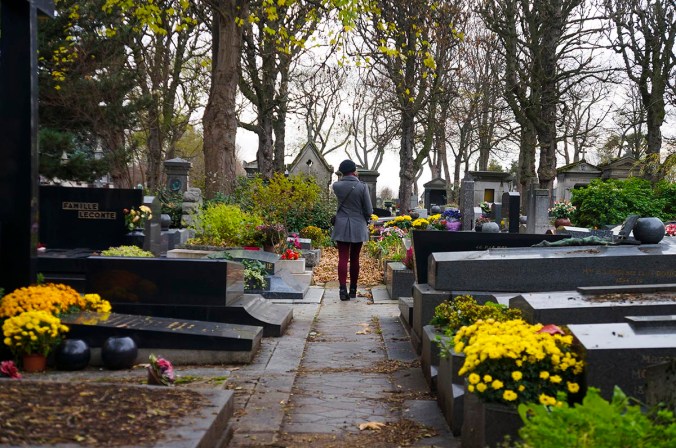
Our first stop was chosen due to simple proximity — the Père LaChaise Cemetery was near our AirBnB place, and was on the way of our walk downtown. I didn’t know much about it, even though apparently it’s one of the most famous cemeteries in the world, home to the graves of Oscar Wilde, Voltaire, Edith Piaf, and Jim Morrison. It’s also breathtakingly gorgeous. Mostly composed of ornate above-ground tombs and mausoleums, it reminded me quite a bit of the cemeteries in New Orleans.


We spent an hour or two wandering around, utterly transfixed.


Oscar Wilde’s resting place was suitably larger than life, a blend of elegance, irreverence and sensuality. The lower half of the winged figure is now enclosed in glass, presumably due to visitors tampering with it — notably, the statue’s private parts have been broken off and absconded with. But that doesn’t stop fans from adding their mark in another way: leaving lipstick kisses on the side wall of the monument.


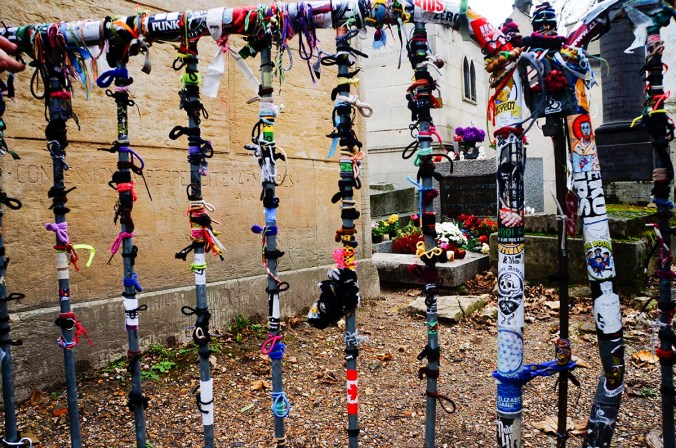
The most-visited grave in the cemetery, however, belongs to Jim Morrison. His grave was actually one of the more drab ones that we saw, but much more interesting was the many tokens left behind by his mourners. A fence blocked off the grave itself, but it was covered in band stickers, bracelets and hair ties.
After leaving the cemetery, we headed toward the downtown area and grabbed some breakfast in a cute cafe. I pulled up a map to plan out our next moves. “Oh look, Haider — the Bastille is right by here,” I said, pointing to Place de Bastille on the map just a few blocks away. “That’d be cool to see!”
After our meal, we headed right for the Bastille, following the large, abundant signs along the way. We reached a large roundabout with an impressive obelisk in the center, a modern opera house, cafes and apartment buildings. No sign of the Bastille, however.
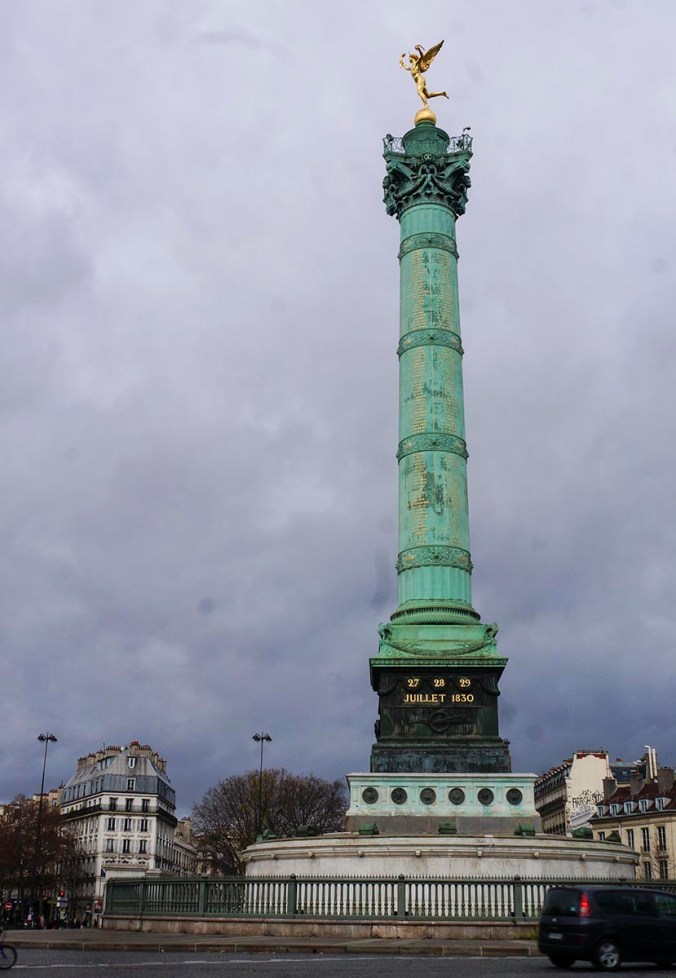
I was quick to give up on it, but Haider wouldn’t be deterred. He flagged down a passerby and asked how to get to the Bastille. The guy gestured all around us — it was here. “No, but the prison?” Haider replied, and was met with a dumbfounded look and a shrug. He had absolutely no idea what we were talking about.
We were puzzled… until we consulted Google, and learned that the Bastille had actually been torn down… in the late 1700s. Thank god that random stranger didn’t realize that we were asking him for the location of a prison that was very famously demolished over 200 years ago.
A few blocks away, we were still laughing about the Bastille debacle when we came upon something that stopped us in our tracks. A relatively nondescript restaurant on the corner was shut down — odd for the bustling time of day — and the sidewalk around it was completely covered with thousands of flowers, candles, photographs and pieces of artwork. A few people were standing around it, crying softly.
It was La Belle Equipe, the site of one of the terrorist attacks.
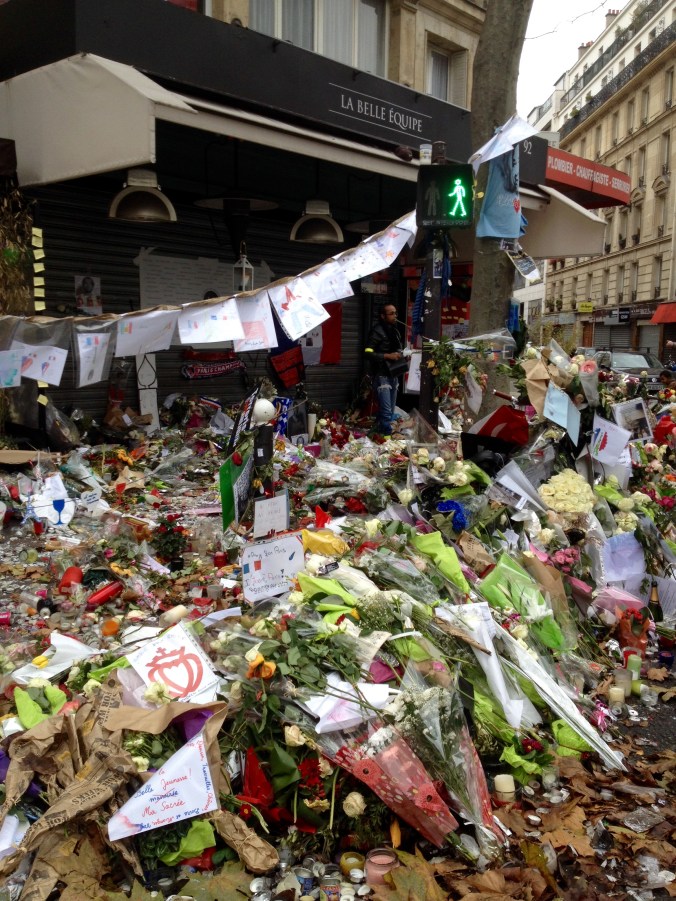
Immediately, we were both flooded with emotion. We weren’t in a particularly fancy or important part of town, it was a restaurant like any number of the thousands across Paris. Not so different from the place that we’d spent that same night in Madrid. Standing before this raw and touching tribute, I was hit hard by the senseless atrocity that had happened here.
Our mood considerably sobered, we kept going, making our way toward the river. Bit by bit, we felt our spirits being lifted again by the rich beauty of our surroundings.


We walked along the Seine for a spell, criss-crossing between the mainland and the islands. The Notre Dame came into view in the distance, gorgeous spectacle of a building that it is.
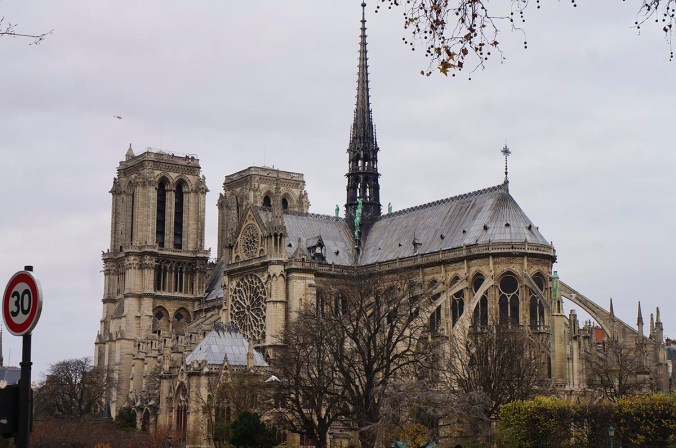
Approaching it, we crossed the famous lover’s bridge covered in locks. It was a sweet sight, but of course made a little hokey by the throngs of street vendors hawking cheap locks engraved with the Eiffel Tower. In some places, there were so many locks on the bridge that people had added bicycle locks just to provide more space to affix the padlocks to. Locks upon locks upon locks, the locks of a thousand lovers. “How many of these couples do you think are even still together?” we couldn’t help but wonder cynically.


The Notre Dame, however, was all authentic awesomeness. Though we didn’t have the time or energy to brave the massive line to see the inside, we were pretty amazed by the building from the outside.


Our explorations took us back and forth across the river a few more times on our way to the Louvre.


Again, we didn’t even consider attempting to go inside. Even if we’d had a full week in Paris, I feel like it’d barely be enough to see the Louvre. But like the Notre Dame, the building from the outside is magnificent all on its own. We wandered through the courtyard and had some fun taking photos with the iconic glass pyramids.


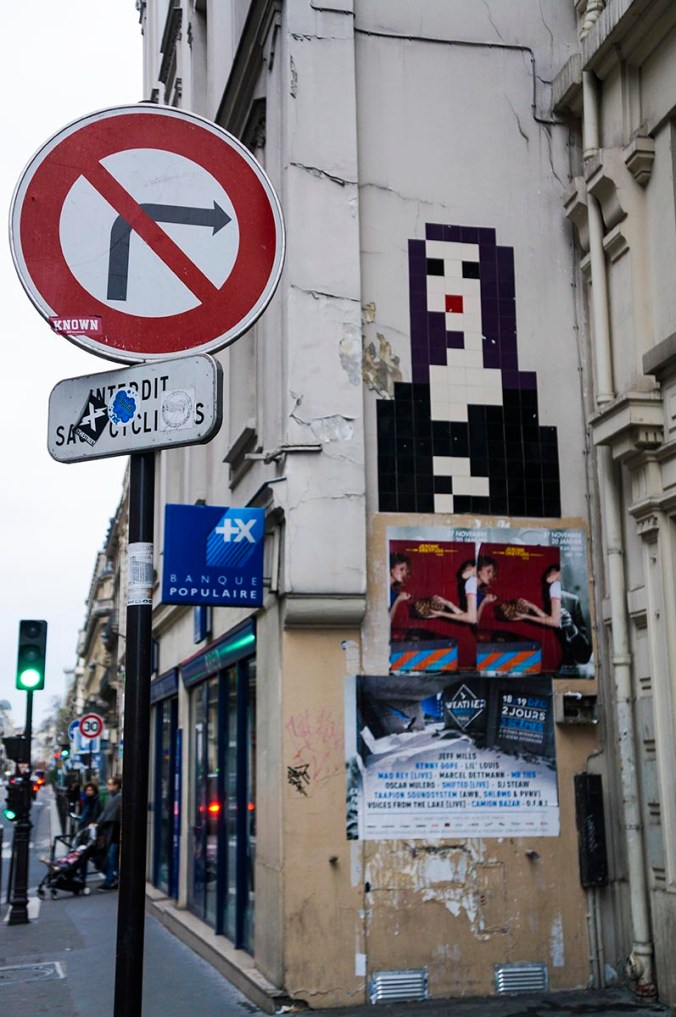
Plus, not to worry — we got to see the Mona Lisa anyway!
Finally, it was time for our main stop. When trying to plan our day, we figured we’d have time to do a proper tour of just one legitimate tourist attraction in addition to all of our meandering explorations. The choice was pretty easy for me. Ever since I’d first heard of them, I’d been fascinated by the idea of the Catacombs, the eerie stone tunnels that crisscross the underbelly of the city and are chock-full of bones.
The tunnels themselves are nearly as spooky and unsettling as the skeletons they contain. Originally part of an extensive limestone quarry, the tunnels are deep, deep below the city — over twice as deep as the metro lines. To access them, you have to go down a tight spiral staircase for what feels like an endless descent (it probably takes about five minutes, which really is quite a long time to be going around and around and around, down down down into the earth).
The first rooms of the catacombs provide tons of interesting information about the geology of the region and the process of mining the limestone. By the late 1700s, however, the city above was getting more and more built up, and the shoddy construction of the tunnels was taking its toll; tunnels were collapsing and creating sinkholes in the streets. Something needed to be done, and after a few decades of rulers attempting to pass off the responsibility, eventually King Louis XVI ordered that the tunnels be inspected and reinforced by engineers.


It was a huge job, and it took years and lots of manpower. One employee in particular had an interesting story. He’d been some type of political prisoner in a fortress on the Spanish island of Mallorca before being released and returning to France to get a job working in the Catacombs. While his colleagues took breaks outside for their meals, or even sometimes while they were home for the night, this man stayed down in the dark tunnels, furiously carving replicas from memory of the complex where he’d been imprisoned.


As the work in the tunnels was wrapping up, a separate problem was developing. The city’s main cemetery, Cimetière Des Innocents, having been used to bury nearly everyone who died in Paris dating back to the Middle Ages, was growing dangerously overcrowded and was turning into a cesspool of disease. The residents of neighboring properties were seeing their basements collapse and a pile of dead bodies rush in from the literally full-to-bursting cemetery next door.
Again, something needed to be done, and the resourceful king saw a way to combine the two problems on his plate. He ordered the cemetery to be closed, and all of the bodies exhumed and relocated into the newly-reinforced tunnels of the Catacombs.
In total, six million skeletons were removed from the Cimetière Des Innocents and others and carefully placed in the Catacombs.
SIX. MILLION. SKELETONS.
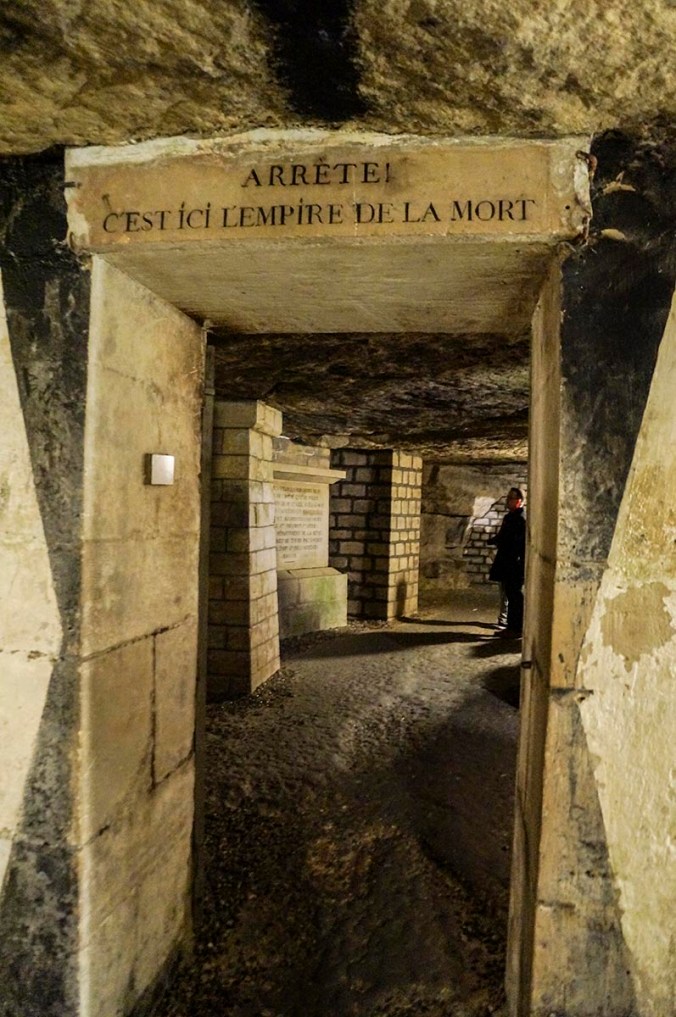
“Halt, this is the empire of the dead.”
It’s kind of impossible to grasp that number until you see it in person. We walked through innumerable rooms with walls lined nearly floor to ceiling with nothing but bones. Femurs and skulls, mostly. Some were arranged into grotesquely whimsical designs like this heart of skulls.


It went on and on and on — and honestly, the craziest part about the experience wasn’t the creepiness of being surrounded by dead bodies, but how quickly we became adjusted to it. After a certain period of time in which you’ve already seen such an unbelievable number of skeletons, your brain just accepts it as normal.


We came out the other end with no idea where we were. The Catacombs are so big (and the tour takes you through only a small part of them) that by the time you finish, you’re in a different part of the neighborhood.
We did know that we were hungry, so we grabbed a bite to eat at a chic pizza place nearby. After this, it was time for the Eiffel Tower.
At the risk of sounding a little basic, I love the Eiffel Tower. Seeing it lit up at night was one of the highlights of my last trip to Europe. En route now, I noticed that Haider didn’t seem to match my level of enthusiasm.
“To be honest, I don’t really care about seeing the Eiffel Tower,” he admitted.
Fair point. It’s one of those world icons that has become so symbolic, so widespread, that it loses meaning. But there really is something striking about seeing it in person, and as soon as we arrived, Haider agreed with me.
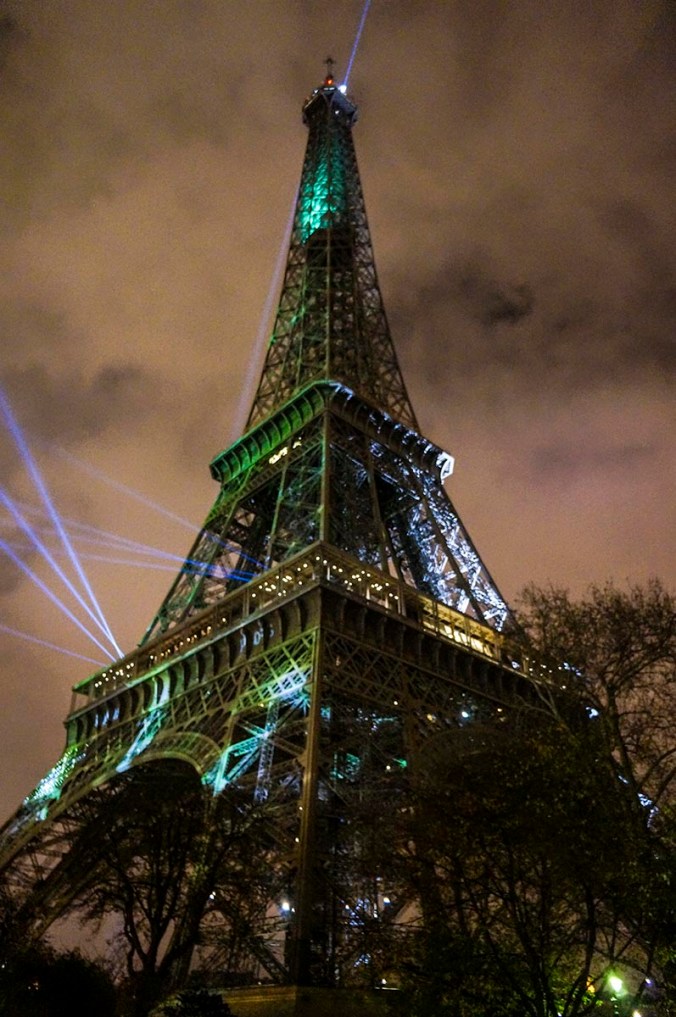
I think the cool part is that we’re all so used to seeing its silhouette from a distance, but when you visit it, you can walk right up to it — and under it, creating that pleasant tingle of vertigo from standing directly below a very very tall structure.
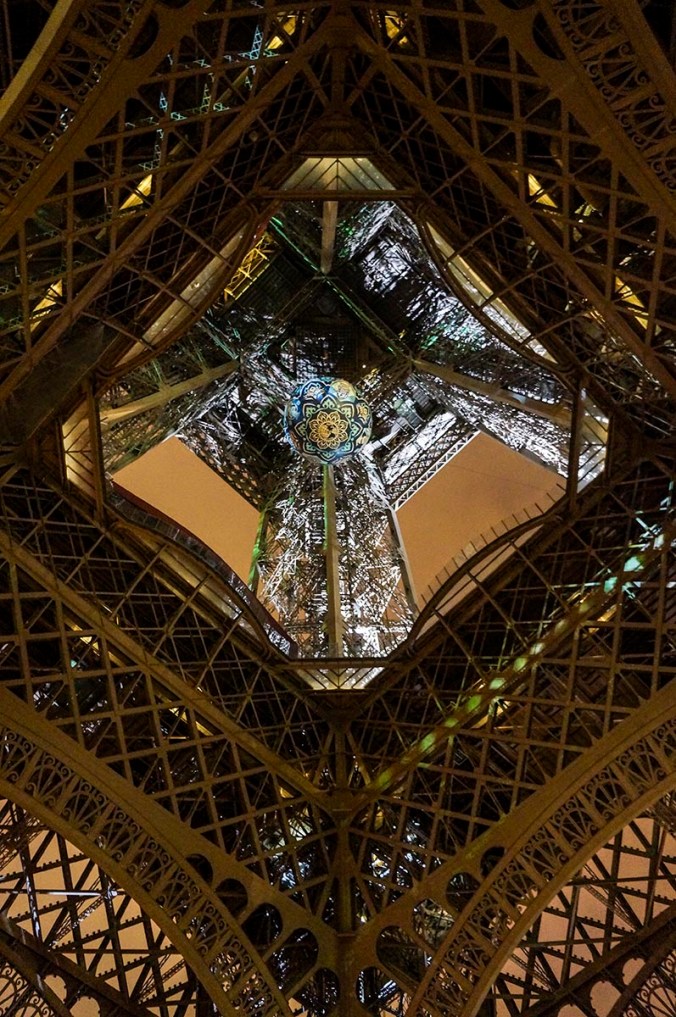
Unfortunately, it wasn’t lit up the way it had been on my previous visit, instead partially illuminated with huge spotlights from below. It was still an outstanding sight, and well worth the visit however cynical you may feel about it.


Our final stop was the neighborhood of Montmarte. I couldn’t resist the chance to see the site of the film that had ignited such an obsession in my 13-year-old self.
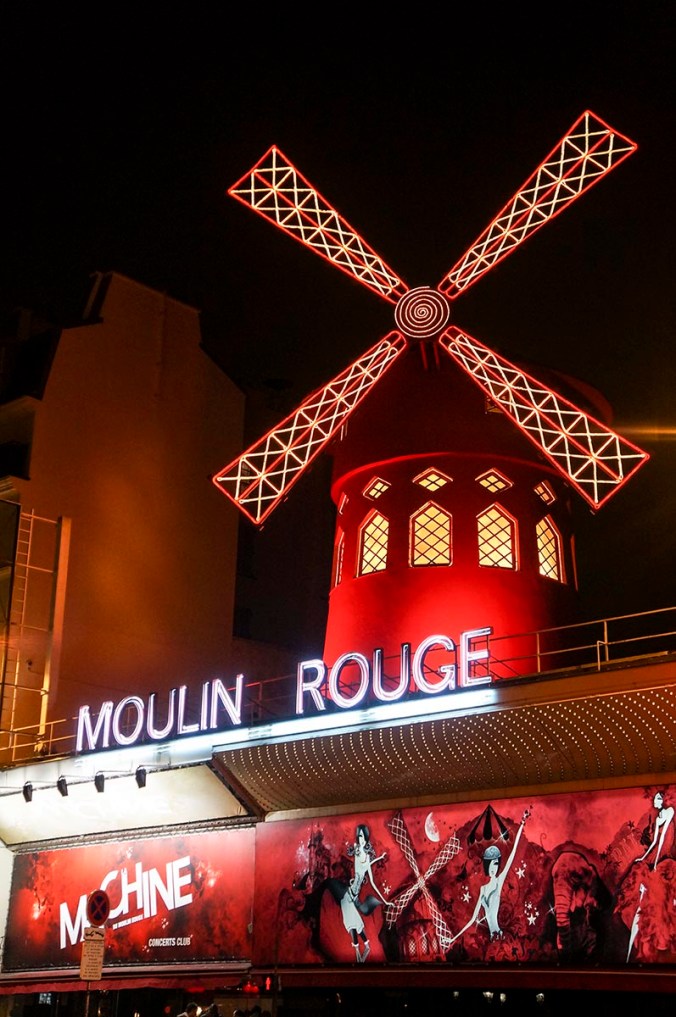
I was satisfied after snapping a quick photo, but we decided to explore Montmarte a bit and wrap up our night with a couple of drinks. As it was a Sunday night the area was quite quiet, but we still got a good taste of the neighborhood’s bohemian character.
Finally, it was time to make our way back to our AirBnB, and the next morning, back to Madrid. We bid a fond adieu to Paris, knowing it’s definitely a place we’ll be returning to for a proper visit sometime soon. And we can rest assure that no matter what happens in the world in the meantime, the City of Light will still be shining just as bright.
 find me in the air
GREAT post. Love that you guys went there right after the attacks. Kudos to you for your good reasoning that it’d be safe, but also to not let the bad guys win. Also, you’re have quite the eye for photography. Well done! 🙂
LikeLike