To be honest, we didn’t think too much about teaching before we signed contracts to do it for nine months in Spain.
Neither of us particularly wanted to be teachers. Joining the auxiliar de conversación (conversation assistant) program wasn’t a career move, but simply a means to an end — to enable us to live in Europe legally for a while and make some money.
And yet, here we are: teachers.
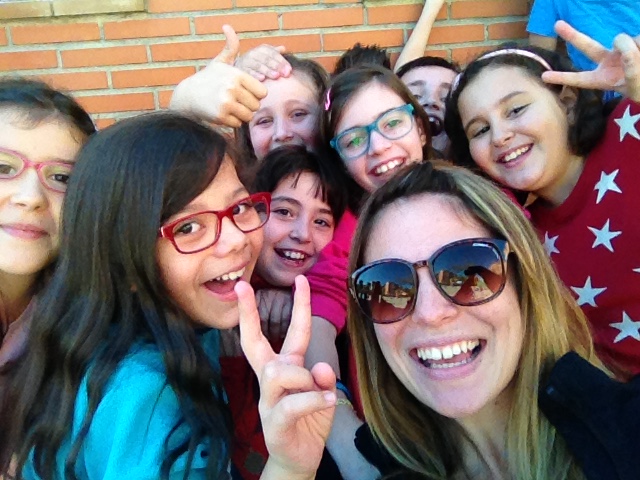
Selfies with some of my third and fourth graders.
I’ll start off with a little bit of background. In light of Spain’s abysmal level of English (compared to the rest of Europe of course — coming from the United States of “Speak American or GTFO,” I’m in no position to judge another country for not being bilingual), the Spanish government created this program, which hires native English speakers to work in public schools as teaching assistants.
The program is officially labeled a “post-graduate internship,” though you can apply at any age and any number of years after graduation. This is (presumably) so that the government can save itself some paperwork by issuing student visas instead of proper working papers. The only actual requirements are to have a bachelor’s degree (in any field of study) and to be a native English speaker (so, a resident of the US, Canada, the UK, Australia or New Zealand). We work 16 hours per week and earn a a stipend of 1000 euros per month in the comunidad de Madrid; in other regions of Spain, you’d work 12 hours and earn 700 euros.
Teaching English to foreigners is a great opportunity to travel and live abroad, and in certain parts of the world (mainly Asia and the richer Middle Eastern countries), also quite lucrative. In Europe, however, it can be pretty difficult to find a well-paying teaching job since most countries have historically had great English education programs and therefore, don’t need a whole lot of help from people whose only professional merit is having grown up speaking the language. In general, it’s tough to find work here in Europe without possessing an EU passport, making it nearly impossible to live here without having a ton of savings or resorting to illegal means. This is exactly what makes the language assistants program so popular — with extremely minimal requirements and a relatively high pay rate (compared to the cost of living here in Spain, 700-1000 euros a month is decently comfortable), it’s a great opportunity to support yourself while you live and travel in Europe.
But it’s still a job. In addition to getting accustomed to Spanish culture, putting together our expat lives here in Madrid and planning our travels, we also have to go to work every day. Okay, four days a week.
Haider and I were both assigned schools in Móstoles, a large suburb to the south of Madrid. But that’s where the similarities end. I work in a bilingual primary school, meaning that half of the subjects are taught in Spanish and half in English, so I assist in English, science, art and gym classes for kids age 6 – 9; one day of the week, I spend a few hours with the 4 year olds in the school’s infantil (preschool/kindergarten) classes. Haider works in two different non-bilingual secondary schools, so he helps out in the English classes for a traditional high school on Tuesdays and Wednesdays, and spends Thursdays and Fridays in a vocational school that teaches older kids (as well as some adults up to their early 30s) the necessary skills to be mechanics, electricians, childcare workers, etc.
In my school, my job varies greatly depending on which teacher I’m working with — I work with four teachers total. One generally hands over the class to me at some point, having me explain the exercises or correct the homework; another selects a small group of kids who are struggling the most in class, tells me what we need to cover, and has me take them to the library to go over the material; another has me spend every period doing individual conversation practice with one student at a time. Each comes with its own set of challenges and rewards, so it’s difficult to say what I actually prefer.
From what I’ve gathered, there isn’t really such a thing as a “typical” auxiliar experience in this program, and everything hinges on what your particular school is like. Mine isn’t perfect, but considering the wide range of possibilities, I got quite lucky. My teachers are super supportive and welcoming, and I am not really asked to prepare much or give any presentations unless I feel comfortable or volunteer (as opposed to some auxiliares who are expected to prepare whole lessons without being given any advance notice on the subject material). My kids are generally pretty sweet and relatively well-behaved, which is good because apparently discipline can be a real nightmare in many schools (like Haider’s!).
The million-dollar question that I was asked by literally everyone before I left is, “How will you teach Spanish kids if you don’t speak any Spanish?” Which is a valid concern. And the answer, it turns out, is: not easily!
Knowing Spanish isn’t a requirement for the program because, in the spirit of immersion, you’re actually not allowed to speak in Spanish to the children. The idea is that if the kids want to talk to you, they’ll be forced to figure out how to say it in English.
This is great in theory! But the reality is that the English level of most of the kids is way lower than it should be, and many things are just straight up impossible to explain to them without using some Spanish. The teachers do what they can, but the kids just don’t get enough practice outside of school hours to fully master the language. And since they’re only taught certain subjects in English, their understanding of the language tends to be quite odd: all my 3rd grade students can tell you that “the brain is the most important part of the nervous system” and “the cerebellum controls voluntary actions” but if you ask them what they did last weekend, you’ll get a blank stare.
So I do think that I’d be more effective in my job if I spoke at least a little Spanish. The teachers largely teach in English, but when kids don’t comprehend something, they’ll just tell them the Spanish translation and get instant understanding — whereas I’m forced to meanderingly explain words like “example” or “bitter” or “metaphor” using only vocabulary that they know, which tends to take much longer than a third grader’s tiny attention span will allow.
Still, I think I’m learning a lot from the challenges, and the moments when I do actually get through to a student are super rewarding.
I’d never spent a ton of time around kids back in the States. Between my four young cousins and my two nieces, I happen to be related to some of the planet’s coolest children, but I only get to see them a few times a year. And spending 16 hours a week outnumbered by elementary school kids is a trip, let me tell you. Already, only two months in to this job, there are so many things I’ve done that I never thought would be a part of my life.
There was the time I was casually munching on a pastry during break and suddenly realized I’d never washed my hands after having to pry a slobbery Band-Aid out of a four-year old’s mouth when I caught her eating it.
There was when a second grader insistently raised his hand or called me over for “help” every ten minutes throughout the class period, only to proudly brandish the bloody tooth he’d just yanked from his gums, fishing for compliments.
There’s the seven-year-old who’s convinced that I’m his actual girlfriend — every time he sees me in the hallways he greets me with “Hola, guapa” (“hey sexy”), winks and tries to kiss me.
And there was the time, only a little over a week in, that one of the teachers was out sick and I was the only one who could cover her class period. I was already super nervous for my first time leading a class on my own, and very nearly walked out when I opened to the page we were supposed to cover that day:

Cringe.
The whole class erupted into giggles every time I said “penis,” and one student raised his hand to ask: “my sister says babies are made like this: *repeatedly slides pointer finger in and out of fist*, what does it mean teacher Cara?” But despite that, it actually wasn’t nearly as bad as I would have thought to explain how babies are made to 30 Spanish nine-year-olds.
From moment to moment, working with these children is delightful, frustrating, rewarding, ridiculous, disgusting, hilarious, infuriating, and heart-warming.
Some days I love the job, and some days I… don’t. But the experience is turning out to be much, much more than just a paycheck and a visa, and I think many of the things I’m learning from it will prove to be useful throughout my life.
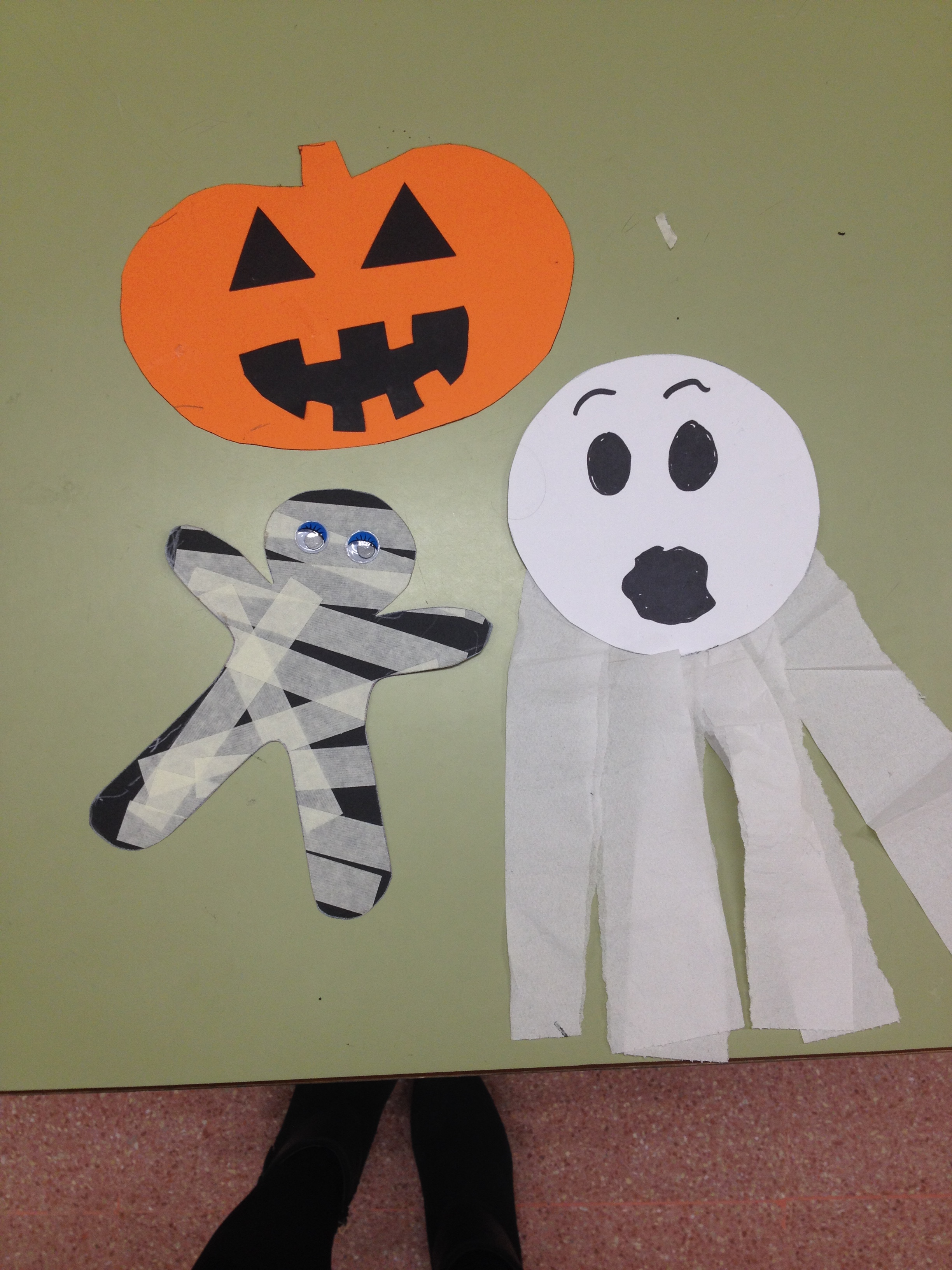
Plus, I got to spend an entire week getting paid to do almost nothing but plan a Halloween party, which definitely appealed to the seven-year-old I am at heart.


If you’re interested in more information about the auxiliar de conversación program, check out this link. The application for the 2016-2017 academic year opens up in early January. In the meantime, feel free to leave a comment or contact me with any questions!
 find me in the air
Thank you Cara for another wonderful, informative ad humorous blog. Love to you and Haider.
LikeLike
Thanks Gram! Glad you are enjoying it! 🙂
LikeLike
Solo 2.5 meses para escribir las experiencias de tu trabajo! Muy cortó!
Si quieres una método a aprender español, escucha a la podcast, “Coffee Break Spanish”. Asista con la conversación y además, la cultura que va con las frases.
Seth
LikeLike
Actualmente, solo 1.5 meses! Empecé trabajar aqui el premier de octubre. Pero, siento como es un mucho mas largo tiempo.
Escucharé a esta podcast. Gracias para la recomendación! Seras feliz a conocer que no he cambiado “excitada” y “emocionada” 🙂
Espero que estas bien! Gracias por leer mi blog.
LikeLike