The next phase of our two weeks in Andalucía took us down to the Mediterranea Sea on the Costa del Sol, then up into region’s mountainous heart. We explored a new city, spent some quality time with the sea, and got our first taste of the romanticism of small town Spain that exists off the beaten tourist path.
Málaga
The morning after Christmas Day, we left Granada behind and headed to Málaga.
The impression we got from talking to a few other travelers was that your opinion of Málaga will largely depend on whether you experience it before or after Granada. While Málaga certainly has its own flair and a nice, laid-back coastal vibe, many of its historical sites pale in comparison to Granada’s.
Regardless, the city is a beautiful place well worth a quick visit.
For starters, there’s the beach and allllll the palm trees. I specifically ruled out spending our break anywhere that felt remotely like Christmas to avoid the homesickness blues, so hanging out in a beach town full of palm trees served as a nice pick-me-up.


Its pastel-colored buildings and narrow, pedestrian-only shopping streets are quite charming, too.


And the harbor, while mobbed with tourists and a tad tacky, was a fun place to explore; touches of modern art added a unique twist.


Then there’s the Alcazaba, a defensive Moorish citadel from the 11th century. Returning to the theme, the oversized shadow of the Alhambra so fresh in our minds definitely detracted a bit from its impact on us, but it’s still a breathtaking structure and an interesting place to explore. It does also boast the recently discovered remains of a 1st century BC Roman theater at its base, which is quite cool and actually free to visit.


The Alcazaba itself is massive, featuring defensive walls, gardens, towers and fountains.


It’s situated at the top of a hill, making it the perfect spot to enjoy views of the ocean, the city, and the mountains beyond — especially while taking a break with beers and a cheese plate from the bar. It’s Spain, of course there’s a bar!


If you’re not afraid of a little hike (disclaimer: it’s not little at all), continue on up the very, very steep hill to the Castillo de Gibralfaro. It was worth the trek; we had a great time wandering around its endless ramparts, and it affords even better views of the surroundings.


We timed our visit so that we wrapped up both the Alcazaba and Gibralfaro by sunset, then descended the hill a bit to catch the day’s colorful end at a lovely mirador.


From up here, you also have a good view of the La Malagueta, the city’s bullfighting ring.
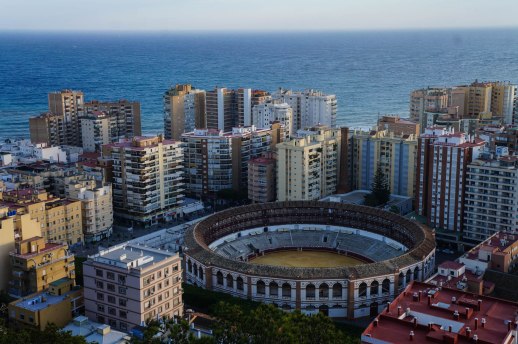
Bullfighting gets a big thumbs down from me, and honestly, most modern Spaniards too. The plazas del toros (bullfighting rings) themselves are not even really much to look at. But it was still interesting to be able to peer inside from a comfortably large distance, and thankfully, while it was not in use. Bullfights only take place regularly in Málaga during a weeklong festival in August, so you don’t have to worry too much about accidentally catching sight of a gory scene.
I’d recommend spending more time in Málaga in the summer when you can enjoy the beaches more, but in the winter, two days was just about enough. I wouldn’t have minded staying a bit longer to catch the Picasso Museum, but early on our third morning, we had to pack our bags and hop a train to…
Benalmádena
Despite being a major destination for beachgoing tourists, when we mention to Spaniards that we visited Benalmádena on our trip, the most common reaction is a scrunched up nose and “Why?”
Not because there’s anything bad about the place, it just doesn’t have much in the way of culture compared to the rest of Andalucia. It was kind of neat to see the European equivalent of the tacky vacation town, though (it’s definitely much prettier than the Jersey Shore)!


But we truly stopped in Benalmadena for one reason only — to finally get our SCUBA DIVING LICENSES.


Scuba diving was very cool, and very terrifying (at first!), and very cold. The area doesn’t have much in the way of biodiversity, so our dives were strictly about the skills, which I look forward to putting to use in a new destination soon! It’s probably for the best that there wasn’t so much to see in the ocean, because it took every ounce of my mental faculties to remember which orifice to breathe out of, maintain the all-important buddy system, and manage to stay level in the water instead of shooting straight up to the surface and then immediately crashing all the way to the bottom. Neutral buoyancy is tough!
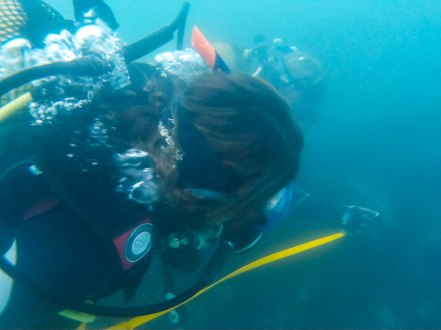
At the end of our two long days spent in the water, we didn’t have much energy left to do anything besides laze around in our hotel room (it was also our first time in 5 days with a double bed and a private room), but we did enjoy some victory drinks next to the ocean that we’d just conquered, and a pleasant stroll through the local towns.


Ronda
Our scuba diver licenses successfully acquired, we headed away from the coast to a small mountain town called Ronda.
Ronda is famous for two things. One of them is its title as the birthplace of modern bullfighting — which made it a difficult task for Haider to convince me to put this little town on our itinerary. But its other claim to fame is quite compelling: Ronda spans a massive gorge, and features a very cool bridge connecting older and newer halves of the town.
Our first sight of the gorge and the bridge was a view that many visitors to Ronda don’t get at all — from the bottom. We’d booked a room in a hostel located inside the gorge itself. Though this made getting into town a colossal pain in the ass, it certainly afforded some one-of-a-kind views.

From the gorge, El Tajo, you have two options to get into town — the “road,” incredibly steep and winding and “paved” with uneven chunks of rock, or the path, only slightly more steep and winding and uneven. Both are exhausting, yet totally worth it for the amazing views of the valley, the mountains beyond, and the gorge itself. We started off at the base of the path next to a donkey grazing in the pasture, who Haider named “Donkey Xote” (think Don Quixote).
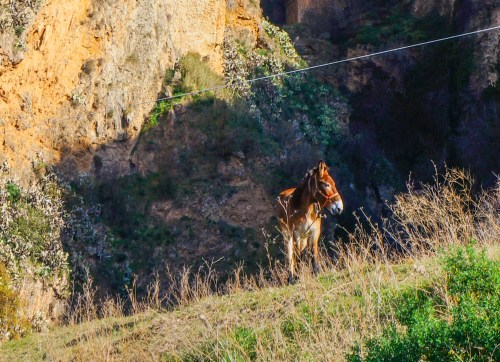
Every few minutes we’d pause to catch our breath and turn around to marvel at how much smaller and further below us Donkey Xote had already become — and how much more of the landscape we could see.


Peering down into El Tajo from the town is dizzying, especially after we learned the legends about prisoners being thrown off the side of the Puente Nuevo bridge during the Spanish Civil War. Though it’s called the New Bridge, it’s really quite old, having been built in the 1700s. It has an interesting history, and the lower part of the structure has seen a variety of uses over the years, including a stint as a jail.


The town of Ronda itself is fairly typical to the region, with white-painted medieval buildings and narrow streets.


The Ronda area has been home to humans since prehistoric times, holding settlements of Celts, Phoenicians and Romans before the tug of war between Moorish caliphates and the Catholics. A great deal of Moorish architecture remains, most of it reworked for Christian purposes after the Islamic empire fell. For example, the Church of Santa Maria la Mayor’s tower was once the minaret of a mosque that occupied the same spot.


Ronda also offers nice shopping and pleasant streets to stroll around in the new town (not nearly as steep as the old part), as well as lots of great places to eat. On a friend’s recommendation we tried out La Lechugita, a great place serving little bite-sized tapas — where you can try just about everything on the menu and spend under 10 euros.


Despite its relatively small size, lovely Ronda was certainly one of the highlights of our Andalucía trip. It came as little surprise that Ronda was once a beloved destination for Los Viajeros Romanticos (the Romantic Travelers). This was a group of people, mostly writers and artists, in the 18th and early 19th centuries who left their homes behind in increasingly industrialized Northern Europe in order to explore purer, unspoiled lands and new cultures. The picturesque landscapes and vibrant culture of Spain drew them in droves.
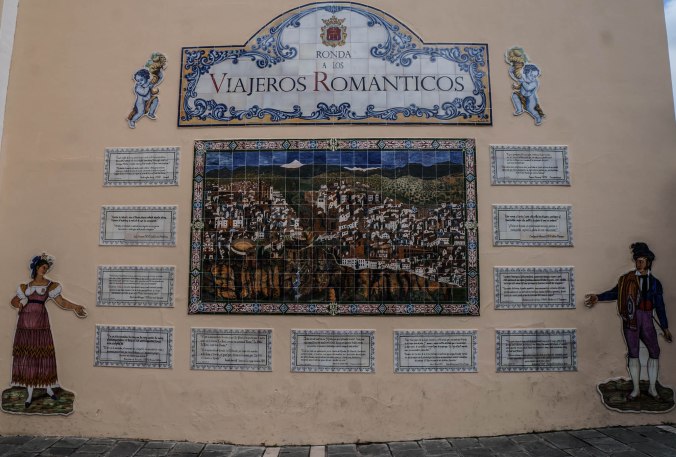
We appreciated this memorial to Los Viajeros Romanticos and found ourselves reflecting on our purpose here in Andalucía, here in Spain, as a continuation of their pilgrimage. The concept that traveling is a good and worthy pursuit is something we may take for granted these days, but back then, it was a new idea. Experiencing more of the world and the beauty that it has to offer has inherent value and importance, and I can feel it enriching my life every time I’m able to take a trip like this one.
 find me in the air
Look out Rick Steves–Cara Meglio just needs video to go with photos!
LikeLike